
For readers
Mystery games for crime fiction lovers.
For anyone who reads with a pencil in hand, has named the killer by chapter three, and has been wrong at least once.
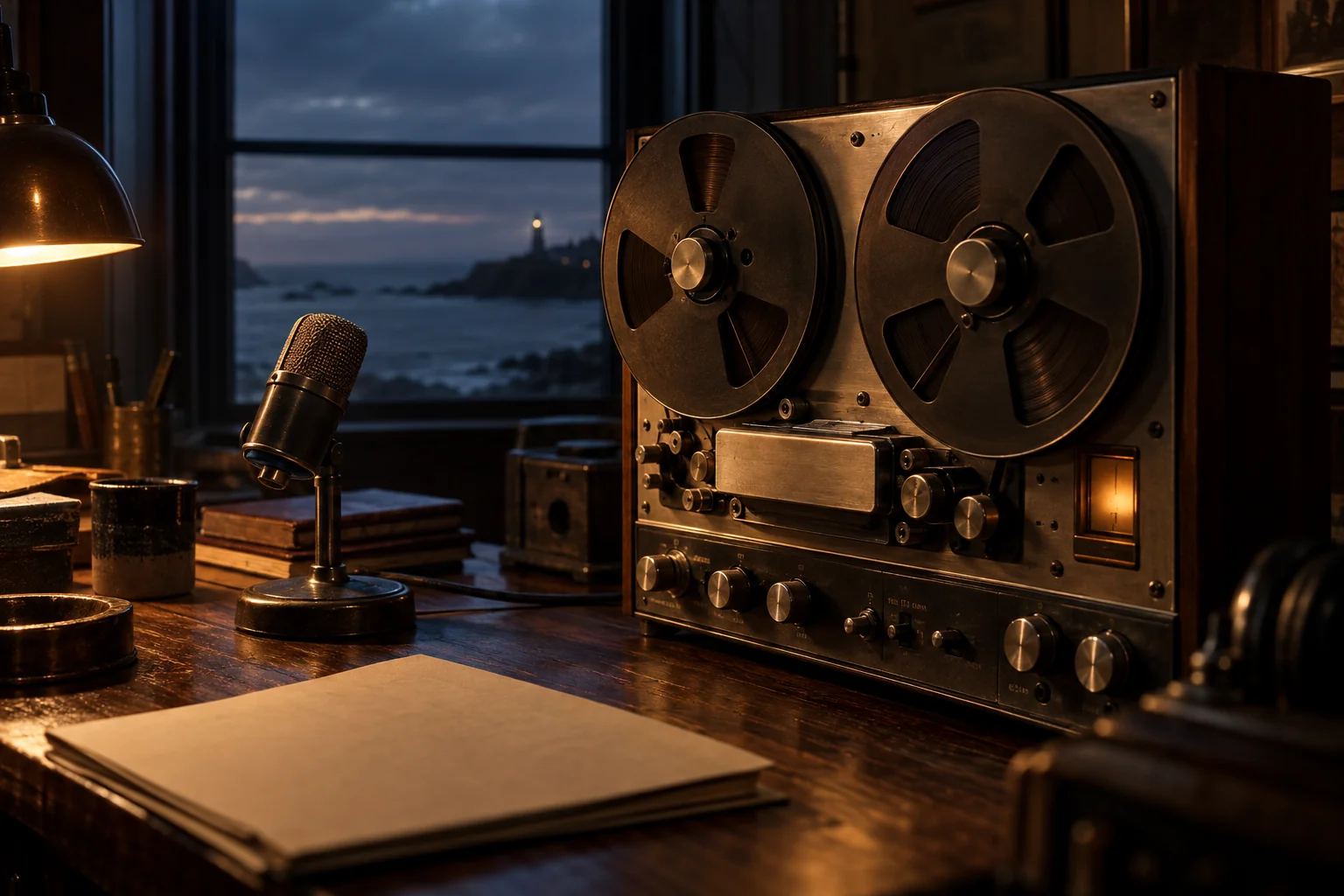
You already know how to do this.
Crime readers are trained detectives. You notice when a character is a little too helpful. You clock a time mentioned in passing and check it against the chapter before. You know an alibi is only as good as the person giving it.
Our cases ask for exactly those habits, then hand you the file. There’s no detective to wait for. You read the statements yourself, check one account against another and decide what the evidence supports. If you feel stuck, optional hints and explanations help you carry on. Every case ends with the full solution, so you can check your reading against the story.
Find your shelf.
If your reading runs from Agatha Christie to Richard Osman, or you can’t resist a Harlan Coben adaptation when the twist is due, you’ll recognise the pleasures here. Those are reference points for taste. Every story below is our own.
If you love the closed circle
When You Hear My Voice
An evening at Halcyon House on the English coast. A plea from a locked room. A husband’s voice over the speakers. At nine, everyone heard Jonah. Twelve minutes later, they found him dead.
Murder · 19 records · £9.99
If you love a friendship with a secret in it
Everything Went to Plan
Four old friends planned to rob the Marram Hotel. The robbery went to plan. By morning, Nell had vanished, and the owner said nothing had been stolen.
Missing person · 20 records · £9.99
If you love a small community with a long memory
The Shortest Day
Eleven winter swimmers wade into the lagoon at Brackwater on the shortest morning of the year. Only ten come back. A founder, her son, and a rule she wrote herself.
Free · 10 records · four acts
What changes when you’re the detective.
A novel decides when you notice things. The author controls the order of every revelation, and the best of them play fair while still steering you somewhere wrong.
Here, the file is in your hands. You read the records, return to any of them and keep your own notes. New evidence opens as you work: a lead followed, a record requested, a finding confirmed. Each case gives you its own way to put that evidence to use. In the longer cases, your findings and final choices shape the ending you read.
It’s a more personal kind of reading. Sometimes you’ll be wrong, and it will be entirely your own doing. That’s half the pleasure.
Read a family argument as evidence.
These two messages are from the opening act of The Shortest Day. Owen is discussing a valuation of his mother’s swimming club.
21:14 · Owen: The agent can come Tuesday. It's only a valuation.
21:30 · Fran: The club stays until I can't get up that ladder. Not a day before.
Try reading between the lines. Write down what each person wants. Then check whether either message confirms an agreement.
Read our take on the exchange
Owen proposes a valuation. Fran gives a condition for keeping the club. Those are two positions in an argument; this excerpt doesn’t confirm that the agent’s visit was agreed. Keep that open question in your notes. The same close reading that helps you follow a crime novel gives you a useful starting point here.
Two opening-act messages, quoted from our game. Their later significance is left for you to discover.
Written to the old rules.
The Golden Age writers took one rule seriously: the reader must see every clue the detective sees. Ronald Knox set it down in his 1929 decalogue, and members of the Detection Club promised not to hide vital clues from the reader.
We write to the same principle. Each case is an authored story with one true solution, told through the records it leaves behind. Every clue you need is in the file. Hints are there if you want them, but nothing depends on luck, trick questions or information you couldn’t have had.
Bring your reading group.
A case makes an unusually good evening for two people from a book club, or two friends who swap paperbacks. Read the same statement, then each say what you think it proves before you compare notes. You will disagree. The evidence will settle it.
Our cases are written for one or two people at one screen. With a bigger group, one person can read aloud while the others argue, but everyone shares the same device.
Questions readers ask.
Do I need to be good at puzzles?
The cases are about reading people and records, not ciphers or logic grids. If you enjoy a twisty novel and can spot when a story doesn’t add up, you have the skills. Optional hints help when you’re stuck.
Are they gory?
No. There is no graphic imagery. The stories deal with adult themes, including death, and each case page lists its themes before you begin.
How long does a case take?
Playing time varies with how closely you read and whether you use hints. There’s no timer, and progress saves in your browser when storage is available, so you can stop between acts and come back.
Are the cases based on real crimes?
No. Every case is fiction, with invented people and places.
Can I play alone?
Yes. One player sees every record and can reach the ending alone. Two people can also share a screen and compare theories.
Case & Candle is independent. The authors and programmes mentioned on this page are reference points for taste only. None is affiliated with our games or endorses them.